Protein Expression Services
Lentiviral transfection and CRISPR/Cas9 build overexpression and knockout lines — genetically stable tool cells that passage long-term.
Stable cell line development integrates an exogenous gene into the host genome, or edits an endogenous gene directly, to yield a genetically stable model that passages long-term.
The service covers both overexpression and knockout line development, supplying the core tool cells for gene function studies, drug target validation and biologics production.
For nanobodies and other innovative biologics, stable cell lines are the key tool for in vitro efficacy work, antibody screening and preclinical evaluation.
Enquire now →

Proven lentiviral transfection and CRISPR/Cas9 systems with optimised homologous recombination ensure precise, efficient gene editing.
Single-clone screening and validation ensure the modification is inherited stably and the phenotype stays consistent long term.
From strategy and vector construction through transfection or editing to single-clone screening, functional validation and cell bank establishment.
Characterisation at DNA, RNA, protein and functional levels ensures reliable results.

Eight stages from design to cell line delivery, covering both overexpression and knockout line development; outputs and acceptance criteria are in the specifications below.

The cell-line strategy is defined from the target gene, host cell and intended application

The target gene is synthesized and cloned into a stable expression vector, then sequence-verified

Host cells are pretreated and transfected with the completed plasmid

Antibiotic pressure selects a stably integrated pool expressing the target protein

Limiting dilution isolates clones, which are expanded and assayed for expression level

Pilot expression identifies high-expressing, stable candidate clones

Verification at DNA, RNA, protein and functional levels for reliable results

2–3 selected research cell bank (RCB) vials delivered with the cell line dossier and thawing guide
Vector construction 2–3 weeks, transfection and pool selection 2–3 weeks, monoclonal selection and verification 4–6 weeks, expansion and banking 1–2 weeks — roughly 9–14 weeks in total.
Proven lentiviral transfection and CRISPR/Cas9 with optimised homologous recombination give precise, efficient editing; monoclonal selection and verification ensure the modification is stably inherited and the phenotype stays consistent long-term — core tool cells for gene function studies, target validation and biologics production.
Deliverables, acceptance criteria and timelines by experimental stage. The staging differs from the process above: the process shows how a project runs, while this table is the acceptance basis written into the contract.
| Stage | Scope | Deliverables | Standards | Timeline |
|---|---|---|---|---|
| Expression vector construction | The gene of interest is cloned into a stable expression vector, with plasmid preparation and sequence verification | Recombinant stable expression plasmid with sequencing report | Vector correctly constructed and carrying the correct resistance marker | 2-3 weeks |
| Transfection & pool selection | The plasmid is transfected into host cells and a stably integrated pool selected under antibiotic pressure | Mixed stable cell pool with selection report | The pool survives selection and expresses the target protein | 2-3 weeks |
| Single-clone screening & characterisation | Cells are single-cell cloned by limiting dilution, clones expanded and protein expression measured | At least 5 monoclonal lines across a range of expression levels, with an expression report | A genetically uniform clone stably expressing the target protein | 4-6 weeks |
| Cell line expansion & banking | Selected clones are expanded, cryopreserved and tested for post-thaw viability | 2–3 research cell bank (RCB) vials of the selected clones with cell line records and a thawing guide | Post-thaw viability >90% with stable target protein expression | 1-2 weeks |
Gene engineering produced overexpression cell lines for multiple targets, with expression verified by Western blot.
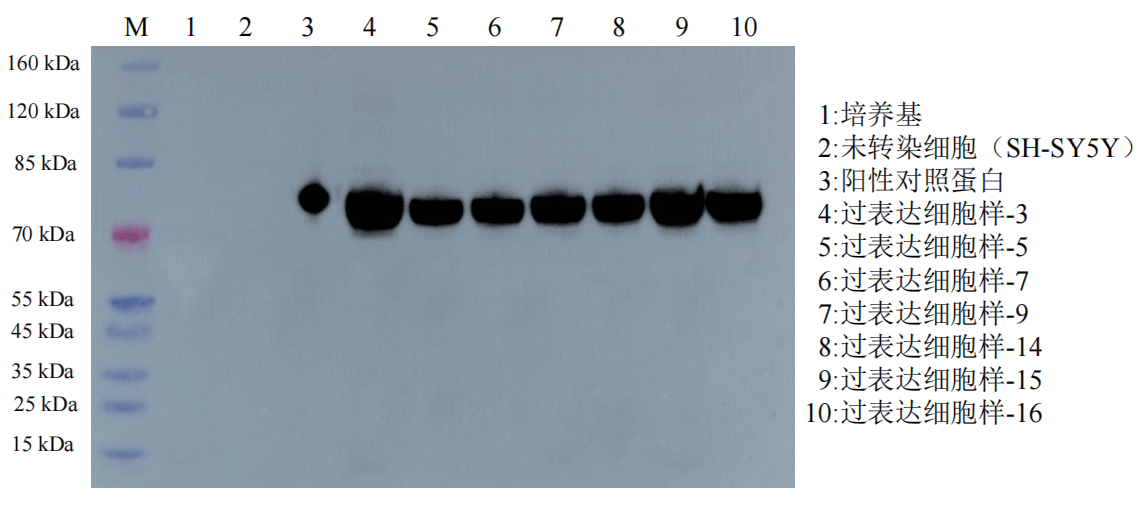
The overexpression monoclonal lines all express the target stably by WB, at levels comparable with the positive control, with clean bands and no notable impurities — indicating high expression purity and strong specificity.
Lanes left to right: 1 medium, 2 untransfected cells (SH-SY5Y), 3 positive control protein, 4–10 overexpression samples -3, -5, -7, -9, -14, -15 and -16.
Share the intended application and what you already have in hand. A scientist — not a sales rep — will scope feasibility, suggest the right route and send a quote, usually within one business day.