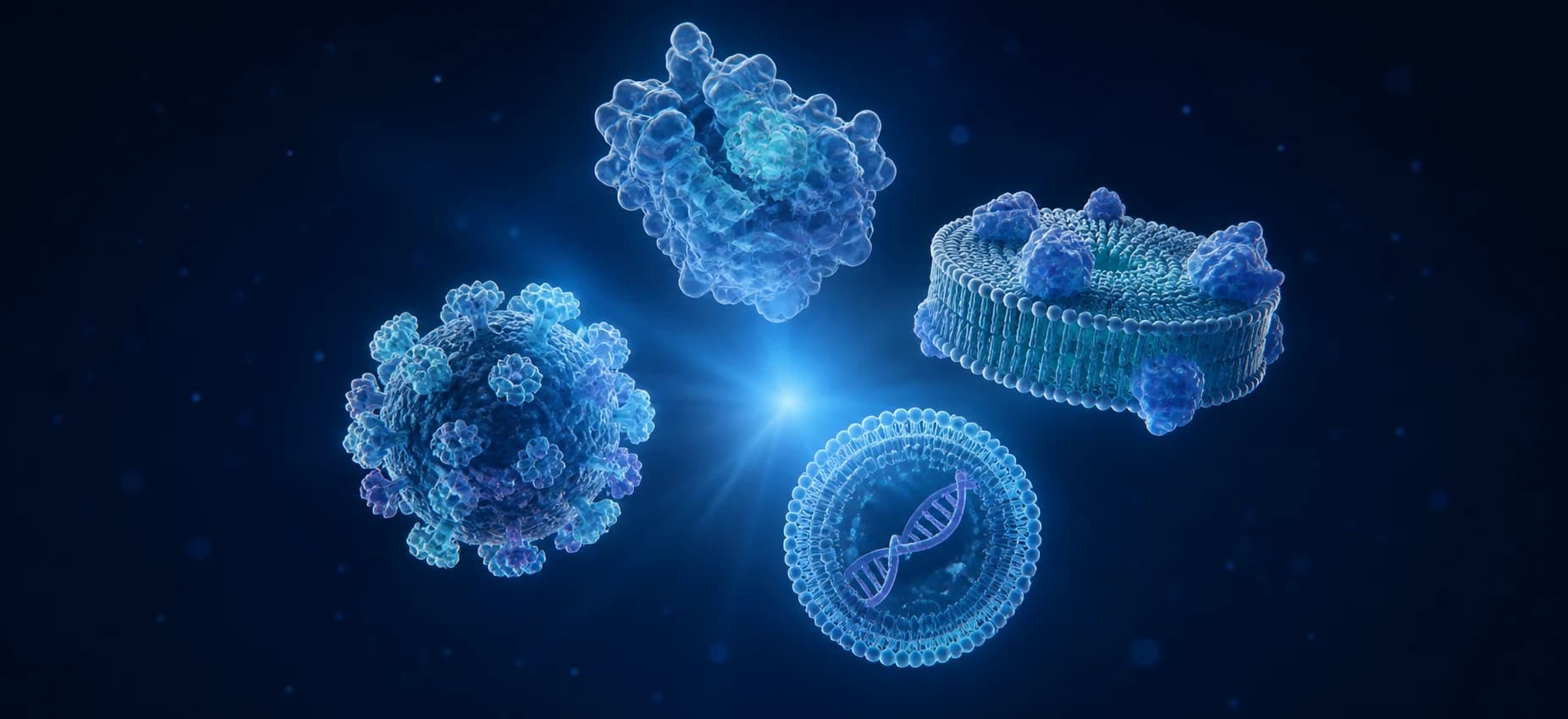
Antigen preparation is the first step of antibody development: four preparation routes—recombinant protein, nanodisc, VLP and mRNA—are matched to target properties, covering complex membrane proteins, conventional proteins, peptides and haptens to provide correctly folded, high-quality antigens for immunization and screening.

Expressed in prokaryotic or eukaryotic systems, the recombinant protein is high-purity and correctly folded for antibody screening, immunisation and assay development.
We provide one-stop custom antigens across every molecule type for antibody drug development, vaccine research and in vitro diagnostics. Four core platforms — recombinant protein, nanodisc, virus-like particle (VLP) and mRNA — address the specific bottlenecks each molecule type brings to antigen preparation.
Whether you need an immunogen for animal immunisation, a detection antigen for antibody screening or a functional antigen for proof of concept, we match the expression system and presentation format to the molecule's structure and its application — delivering from sequence to functional antigen quickly.

The four antigen routes ride on our protein expression platforms: recombinant antigens are expressed in prokaryotic or eukaryotic systems, VLPs self-assemble in insect or mammalian cells, and membrane-protein antigens keep their conformation thanks to our transmembrane expression capability.
 E. coli expression platform
A streamlined prokaryotic system combining short timelines, controlled cost and high yield, supporting rapid scale-up of the target protein.
Learn more Mammalian expression platform
CHO/HEK293 hosts with full folding and post-translational modification give proteins that closely match the native state in structure, physicochemistry and function.
Learn more Baculovirus–insect cell platform
Insect cell hosts with baculovirus-mediated expression bring eukaryotic post-translational modification, enabling high-level production of complex proteins and multi-subunit assemblies.
Learn more
Mesothelin, long underestimated, has moved from the lab to the clinical frontier across CAR-T, ADCs and bispecifics. With our cellular EC50 and internalisation data.
May 27, 2026
Both formats drop parts of the native immunoglobulin. We compare structure, solubility, stability, size and production cost, then their therapeutic use.
Jul 15, 2026

Heavy-chain-only antibodies, found in camelids and cartilaginous fish in the 1990s, lose the CH1 domain and pair no light chain — leaving a single variable domain of roughly 15 kDa, nanometre-scale.
Jun 10, 2026
Antigen conformation decides antibody quality. We match the preparation route to your target and confirm particle size, purity and conformation before delivery, so immunization and screening stand on solid ground.
Share the intended application and what you already have in hand. A scientist — not a sales rep — will scope feasibility, suggest the right route and send a quote, usually within one business day.