Antibody Production
Affinity purification with modified-peptide positive selection and unmodified-peptide counter-selection yields antibodies that precisely recognise phosphorylation, acetylation, lactylation, glycosylation and other modifications.
We specialise in modification-specific antibodies, pairing an advanced technical platform with modified- and unmodified-peptide affinity purification to deliver a precise, efficient custom service.
Raised against sites such as phosphorylation, di-phosphorylation, acetylation, lactylation and glycosylation, the antibodies recognise their specific modification precisely — serving cell signalling, protein structure and function, disease mechanism research and precision diagnostics.
More than ten years of experience and a strong technical team keep specificity high and batches stable, making the custom process rigorous, transparent and controllable.
Enquire now →

Structure-based rational design optimises the binding region for high specificity and affinity.
A mature process platform keeps projects on schedule and delivers in full.
ELISA titre reaches ≥1:256,000, with a commitment to pass the validation experiment you specify.
An MSc/PhD team with 15+ years of industry experience supports the project throughout.

Six stages: immunize with the modified peptide, then purify by modified-peptide positive selection and unmodified-peptide counter-selection; outputs and acceptance criteria are in the specifications below.
Modified and unmodified peptides synthesised (2 mg, >95% purity)

Standard immunization protocol over 8–10 weeks
Antiserum ELISA titre testing, titre ≥1:256,000
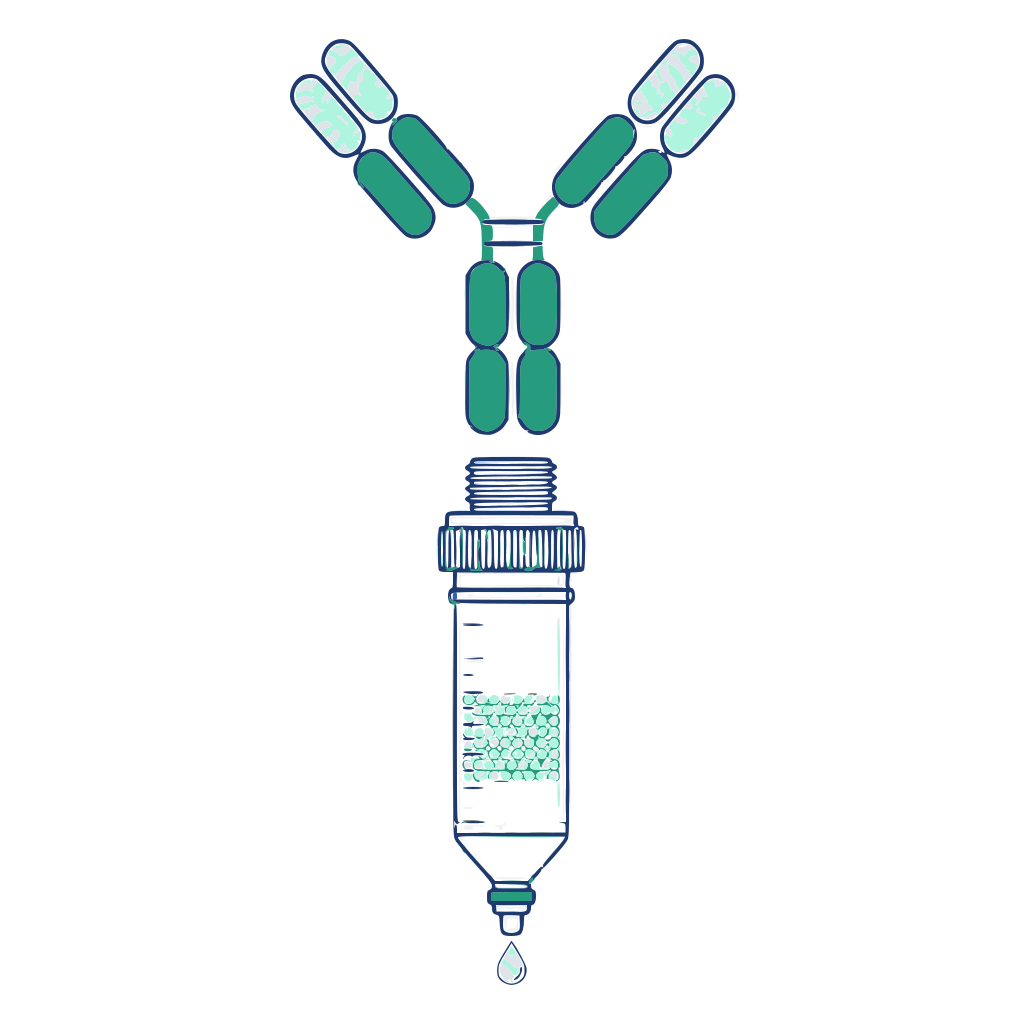
Antigen affinity purification — modified-peptide positive and unmodified-peptide counter-selection

SDS-PAGE/ELISA/WB — binding-curve EC50 <10 nM, WB-positive
0.5–2 mg purified antibody (≥95% purity) with the CoA delivered
Immunization runs 8–10 weeks with 3 days each for titre, purification and QC; synthesis of the modified and unmodified peptides adds 3–5 weeks.
Antibodies raised against phosphorylation, di-phosphorylation, acetylation, lactylation, glycosylation and other sites recognise their modification precisely — serving cell signalling, protein structure–function, disease mechanism and precision diagnostics work with assured specificity and batch stability.
Deliverables, acceptance criteria and timelines by experimental stage. The staging differs from the process above: the process shows how a project runs, while this table is the acceptance basis written into the contract.
| Stage | Scope | Deliverables | Standards | Timeline |
|---|---|---|---|---|
| Antigen preparation | Synthesis of modified and unmodified peptides | 2 mg peptide | Purity >95% | 3–5 weeks |
| Animal immunization | Standard immunization protocol | Pre-immune serum; 10–20 mL antiserum | / | 8–10 weeks |
| Titre testing | Antiserum ELISA titre testing | Titre report | Titre ≥1:256,000 | 3 days |
| Antibody purification | Antigen affinity purification (positive selection on modified peptide, counter-selection on unmodified) | 0.5–2 mg purified antibody | Purity ≥95%, positive-selection ELISA >2.0, counter-selection ELISA <0.3 | 3 days |
| QC testing | SDS-PAGE / ELISA / WB | Certificate of analysis (CoA) | ELISA binding curve EC50 <10 nM, WB-positive | 3 days |
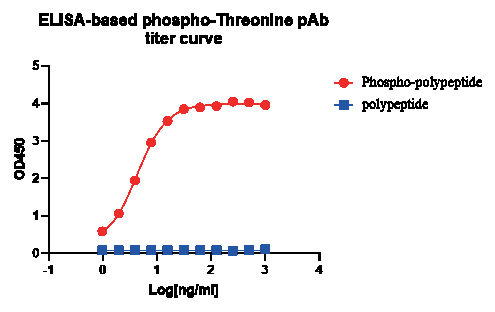
ELISA: the antibody specifically recognises the phosphorylated peptide (red curve) with no notable response to the unmodified peptide (blue curve) — good sensitivity and specificity.
Share the intended application and what you already have in hand. A scientist — not a sales rep — will scope feasibility, suggest the right route and send a quote, usually within one business day.