Document not yet available
ManualCOAMSDS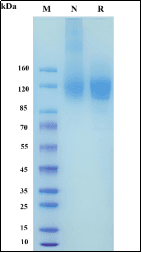
OSMR (IL-31RB), a type I cytokine receptor, is an oncostatin M receptor subunit. It heterodimerizes with IL-6 signal transducer or IL-31 receptor A to form functional receptors for oncostatin M and IL-31, respectively, and transduces their signaling. OSMR mutations cause hereditary primary localized cutaneous amyloidosis type 1 (PLCA1, familial lichen amyloidosis), featuring localized skin amyloid deposition, lower-limb pruritus, hyperpigmentation and lichenification worsened by persistent scratching. Amyloid deposits consist of degraded keratin filaments, serum amyloid P component and immunoglobulins.
| Synonyms | Oncostatin-M-specific receptor subunit beta, Interleukin-31 receptor subunit beta, IL-31 receptor subunit beta, IL-31R subunit beta, IL-31R-beta, IL-31RB,OSMR,OSMRB |
|---|---|
| Protein Construction & Source | ·Recombinant Human(Uniprot: Q99650-1) OSMR Protein is expressed from HEK293 cells with Avi-His tag at the C-terminus.It contains AA Glu 28- Met 740.·The protein has a predicted MW of 84.7 kDa. The protein migrates as 110-140 kDa when calibrated against under reducing (R) condition (SDS-PAGE) due to glycosylation. |
| Endotoxin | < 0.1 EU per ug as determined by the LAL method. |
| Purity | >85% as determined by SDS-PAGE. |
| Concentration & Formulation | ·1.38 mg/mL ·Filtered through a 0.22 μm filter, stored in 1x PBS, pH 7.4. |
| Transportation & Storage | ·This product is shipped under low-temperature conditions. Avoid repeated freeze-thaw cycles during handling.·Protein solution can be stored at 2-8°C for 2-7 days.·Samples are stable for 3 months from date of receipt at -20℃ /-80℃. ·Recommend to aliquot the protein into smaller quantities for optimal storage. |
| Target background | OSMR (IL-31RB), a type I cytokine receptor, is an oncostatin M receptor subunit. It heterodimerizes with IL-6 signal transducer or IL-31 receptor A to form functional receptors for oncostatin M and IL-31, respectively, and transduces their signaling. OSMR mutations cause hereditary primary localized cutaneous amyloidosis type 1 (PLCA1, familial lichen amyloidosis), featuring localized skin amyloid deposition, lower-limb pruritus, hyperpigmentation and lichenification worsened by persistent scratching. Amyloid deposits consist of degraded keratin filaments, serum amyloid P component and immunoglobulins. |
|---|
For research use only. Not for use in diagnostic or therapeutic procedures.
Share the intended application and what you already have in hand. A scientist — not a sales rep — will scope feasibility, suggest the right route and send a quote, usually within one business day.